
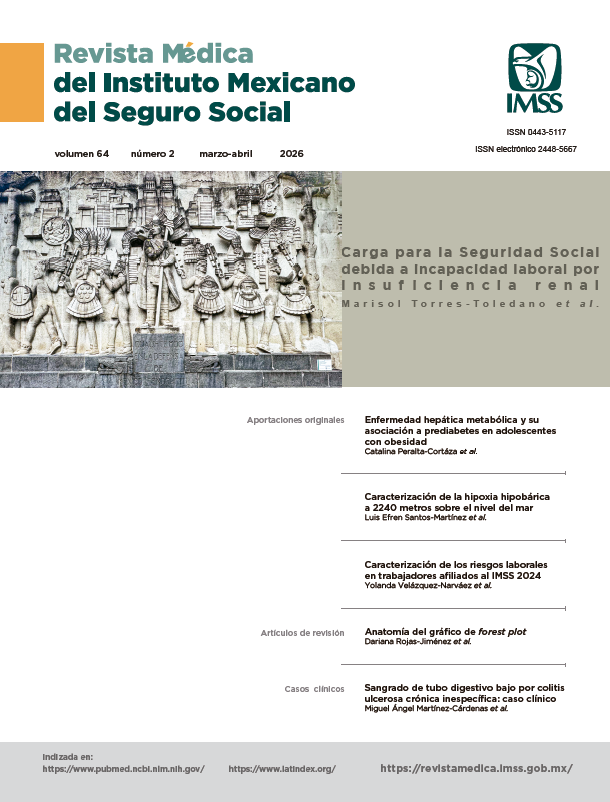
Characterisation of hypobaric hypoxia at 2240 metres above sea level
Main Article Content
Keywords
Altitude, Blood gas analysis, Oxygenation, Hypoxia, Pulse oximetry
Abstract
Background: Hypobaric hypoxia is little known in healthy subjects at 2240 meters above sea level.
Objective: To characterize hypobaric hypoxia in healthy subjects at 2240 meters above sea level.
Material and methods: Healthy subjects residing in Mexico City were studied using an analytical cross-sectional design. Their demographic and oxygenation variables were analyzed by gender using the t test for independent variables and p < 0.05. Oxygenation indices were characterized using Pearson's correlation coefficient, intraclass correlation coefficient, and coefficient of determination.
Results: A total of 244 healthy subjects residing in Mexico City, aged 49 ± 9, 122 (50%) males, were studied; body mass index in men: 22.92 ± 1.63 versus 22.87 ± 1.43 in women, p = 0.792. Total PaO2 was 69.88 ± 4.46; total SpO2 was 93.93 ± 1.90; PaO2/FiO2 ratio was 333 ± 21 and adjusted for barometric pressure was 256 ± 16; SpOFI/FiO2 was 447 ± 9 and adjusted for barometric pressure was 344 ± 7. The PaO2/FiO2 - SpOFI/FiO2 correlations were r = 0.631, p = 0.0001, and adjusted r = 0.629, p = 0.0001, concordance by intraclass correlation coefficient of 0.624 (substantial) and an adjusted of 0.543 (moderate). The coefficient of determination 39.8%, adjusted for barometric pressure 39.5%.
Conclusions: At 2,240 meters above sea level, oxygenation variables indicate the presence of hypobaric hypoxia. The oxygenation indices correlate with moderate to substantial concordance.
References
1. Murillo JC, Salinas SC, López MJJ, Villena CM. Función ventricular derecha en residentes nativos a gran altura. J Health Med Sci. 2020;6(2):113-22.
2. Santos-Martínez LE, Gómez-Tejada RA, Murillo-Jauregui CX, Hoyos-Paladines RA, Poyares-Jardim CV, Orozco-Levi M. Exposición crónica a la altura. Características clínicas y diagnóstico. Arch Cardiol Mex. 2021;91(4):500 - 07. Doi:10.24875/ACM.20000447.
3. Santos-Martínez LE, Arias-Jiménez A , Quevedo-Paredes J, Gómez-López L, Ordoñez-Reyna A, Moreno-Ruiz LA. Caracterización de los parámetros del intercambio gaseoso en la ciudad de México. Rev Med Inst Mex Seguro Soc. 2021;59(6):473-81.
4. Pérez-Padilla R. Adaptation to moderate altitude hypoxemia: The example of the valley of Mexico. Rev Invest Clin. 2022;74(1):4-15. doi:10.24875/RIC.21000159.
5. Cid-Juárez S, Téllez-Navarrete NA, Bautista-Bernal A, Leon-Gomez P, Salas-Escamilla I, Gochicoa-Rangel L, et al. Arterial blood gases in normal subjects at 2240 meters above sea level: Impact of age, gender, and body mass index. Rev Invest Clin. 2023;75(1):29-36. Doi: 10.24875/RIC.22000281.
6. Vélez-Páez JL, Castro-Bustamante C, Avellanas-Chavala ML. Gasometría y altitud: investigaciónde los rangos de normalidad en Quito, Ecuador (2.850 m sobre el nivel del mar). Med Intensiva. 2025; 49(6): 502140. Doi: 10.1016/j.medin.2025.502140.
7. Vázquez-García JC, Pérez-Padilla R. Valores gasométricos estimados para las principales poblaciones y sitios a mayor altitud en México. Rev Inst Nal Enf Resp Mex. 2000; 13(1): 06 - 13.
8. Zhang SF, Lin SX, Gao W, Liu HP, Liu Y, Zhang DH, et al. Report of the consensus conference on diagnostic criteria of ALI/ARDS at high altitudes in Western China. Intensive Care Med. 2001;27:1539-46. Doi:10.1007/s001340101052.
9. Pérez-Padilla R. Population distribution residing at different altitudes: Implications for hypoxemia. Archives of Medical Research 2002; 33(2) :162-6. Doi:10.1016/s0188-4409(01)00377-0.
10. Vazquez-García JC, Hernández-Centeno RJ, Arroyo-Hernández M, Elizondo-Ríos A, Casillas-Suarez C, Cortés-Tellez A, et al. Guía de practica clínica mexicana de EPOC 2025. Neumol Cir Tórax. 2025;84(Supl.1):S8-S108. Doi: 10.35366/119442.
11. Orozco-González BN, Rodriguez-Plascencia N, Palma-Zapata JA, Llamas-Domínguez AE, Rodríguez-González JS, Diaz JM, et al. Obesity hypoventilation syndrome, literature review. Sleep Adv. 2024;5(1):zpae033. Doi: 10.1093. sleepadvances/zpae033.
12. Jone PN, Ivy DD, Hauck A, Karamlou T, Truong U, Coleman RD, et al. Pulmonary hypertension in congenital heart disease: A scientific statement from the American Heart Association. Circ Heart Fail. 2023;16(7): e00080. Doi: 101161/HHF.0000000000000080.
13. Avila-Hilari A, Tinoco-Solórzano A, Vélez-Páez J, Molano Franco D, Montelongo FJ, Avellanas-Chavala ML. Síndrome de distrés respiratorio agudo en la altitud: consideraciones sobre el diagnóstico y tratamiento. Med Intensiva. 2024;48:546 - 54. Doi:10.1016/j.medin.2024.04.006.
14. Viruez-Soto JA, Jiménez-Torres F, Sirpa-Choquehuanca V, Casas-Mamani R, Medina-Vera M, Vera-Carrasco O. Gasometría arterial en residentes a gran altura, El Alto - Bolivia 2020. Revista Cuadernos. 2020; 61(1):38-43.
15. Vera-Carrasco O. Ajuste de la relación o cociente PaO2 / FiO2 a la presión barométrica en la ciudad de la Paz 3600 MSNM. Revista Cuadernos. 2022; 63(2):62-7.
16. Matthay MA, Arabi Y, Arroliga AC, Bernard G, Bersten AD, Brochard LJ, et al. A New global definition of acute respiratory distress syndrome. Am J Respir Crit Care Med. 2024; 209 (1), 37- 47. Doi:10.1164/rccm.202303-0558WS.
17. Pérez-Padilla JR. La fisiología de Daniel Vergara Lope Escobar. Reinterpretación de algunos de sus datos. Gac Méd Méx. 2004; 140(4): 417-21.
18. Santos-Martínez LE. Consideraciones sobre la hipoxia y la altitud. Rev Med Inst Mex Seguro Soc. 2025;63(5):e6725. Doi: 10.5281/zenodo.16748358.
19. Rodríguez-Roisin R, SEPAR. Normativa sobre la gasometría arterial. Arch Bronconeumol 1998;34(3): 142 - 53. Doi: 10.1016/S0300-2896(15)30471-3.
20. Santos-Martínez LE, Gómez-López L, Arias-Jiménez A, Quevedo-Paredes J. Deterioro del intercambio gaseoso en sujetos con incremento del indice de masa corporal a una altitud de 2240 metros sobre el nivel del mar. Arch Cardiol Mex. 2021;91(1):7-16. Doi: 10.24875/ACM.20000407.
21. Allen EV. Thromboangeitis obliterans: Methods of diagnosis of chronic occlusive arterial lesions distal to the wrist with illustrative cases. Am J Med Sci. 1929;178:237- 44.
22. Dukić L, Kopčinović LM, Dorotić A, Baršić I. Blood gas testing and related measurements: National recommendations on behalf of the Croatian Society of Medical Biochemistry and Laboratory Medicine. Biochem Med (Zagreb). 2016;26(3):318-336. doi: 10.11613/BM.2016.036.
23. Santos-Martínez LE, Ureña-Plascencia MV, Quevedo-Paredes J, Colín-Chávez NI, Durán-Vidauri JP, Soto-Márquez P. Diferencias en la saturación parcial de oxígeno obtenido de 3 oxímetros de pulso. Rev Med Inst Mex Seguro Soc. 2020;58(4):385-93. Doi: 10.24875/RMIMSS.M19000062.
24. López-Fermín J, Escarramán-Martínez D, Sánchez Díaz JS, Pérez Nieto OR. Ratio de oxígeno como determinante de severidad en neumonía COVID-19. Rev Chil Anest. 2023; 52 (7): 678-82. Doi:10.25237/revchilanestv52n7-08.
25. Kramer MS, Feinstein AR. Clinical biostatistics LIV. The biostatistics of concordance. Clin Pharmacol Ther. 1981;29(1):111-23.
26. Casado A, Prieta L, Lamarca R. La evaluación de la fiabilidad en las observaciones clínicas: el coeficiente de correlación intra-clase. Med Clin (Barc). 1998;110: 145-55.
27. Tinoco-Solorsano A, Avila-Hilari A, Avellanas-Chavala ML, Montelongo FJ, Vélez-Páez J, Nieto-Estrada V, et al. Definiciones y recomendaciones de consenso sobre la medicina critica en la altitud del comité expertos de medicina crítica en la altitud de la Federación Panamericana e Ibérica de Medicina Crítica y Terapia Intensiva. Med Intensiva. 2025: Doi:10.1016/j.medin.2025.502256.
28. Tinoco-Solórzano A, Román-Santamaría A, Charri-Victorio J. Gasometría arterial en diferentes niveles de altitud en residentes adultos sanos en el Perú. Horiz Med 2017; 17(3): 6-10. Doi: 10.24265/horizmed.2017.v17n3.02.
Article Sidebar

This work is licensed under a Creative Commons Attribution-NonCommercial-NoDerivatives 4.0 International License.
Authors retain their copyright and grant the Revista Médica del IMSS the right of first publication. Articles are distributed under a Creative Commons Attribution-NonCommercial-NoDerivatives 4.0 International License, which allows sharing as long as the author and the original source are properly credited.