
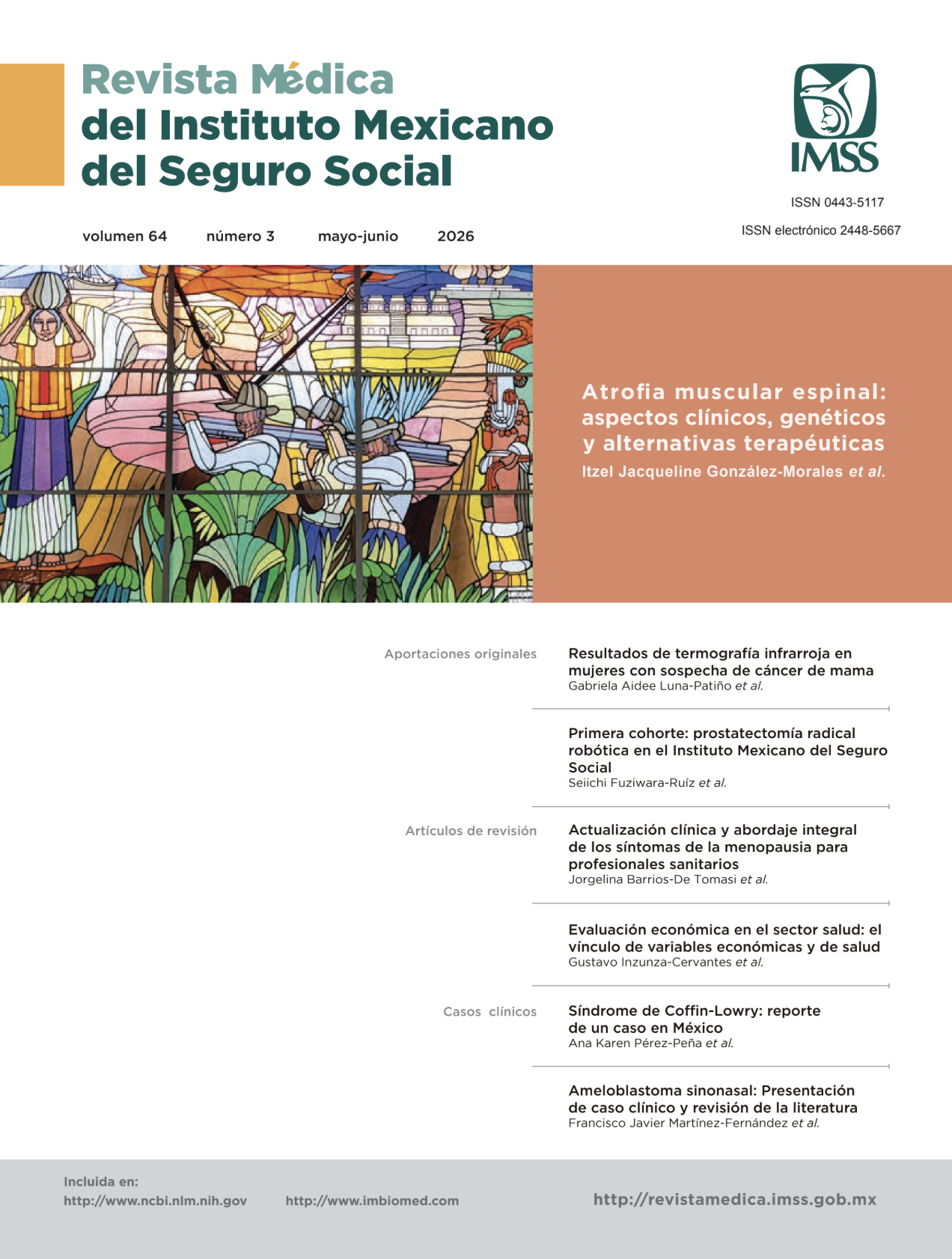
First cohort: Robotic radical prostatectomy at the Mexican Institute for Social Security
Main Article Content
Keywords
Prostatic Neoplasms, Prostatectomy, Robotic Surgical Procedures, Social Security
Abstract
Abstract
Background: Prostate cancer is the most common cancer in men and the leading cause of malignancy-related mortality in Mexico. The Mexican Institute for Social Security (IMSS for its initialism in Spanish) introduced its first robotic system at the Oncology Hospital of the 21st Century National Medical Center in Mexico City.
Objective: To evaluate the accumulated experience, perioperative, oncologic and functional outcomes of the first 200 robot-assisted radical prostatectomy (RARP) cases.
Material and methods: A retrospective analysis of 200 patients undergoing RARP for localized prostate cancer was conducted. Perioperative and postoperative variables, pathology results, complications, and one-year continence rates were considered.
Results: Mean surgical time was 242.1 minutes (90-600), with a console time of 197.6 minutes (68-495). Mean blood loss was 327.7 cc (10-1800). Positive surgical margins were observed in 34.5% of cases. Complications occurred in 22 patients (11%). No conversions to open surgery or mortality were reported. Mean hospital stay was 2.54 days (2-14). Postoperative antigen was undetectable in 88.5% of patients. The continence rate was 95.7%.
Conclusions: The first 200 RARP cases at our institution demonstrate the accumulated experience with the procedure, showing low complication rates. These results are consistent with those of high-volume centers, which require additional long-term functional follow-up.
References
1. Globocan Cancer Observatory: Cancer Today. International Agency for Research on Cancer; 2024. Disponible en: https://gco.iarc.who.int/today
2. Vickers AJ. What are the implications of the surgical learning curve? Eur Urol. 2014;65(3):532-3. doi: 10.1016/j.eururo.2013.11.034
3. Sanchez-Nunez JE, Gonzalez-Cuenca E, Fernandez-Noyola G, et al. Oncological and functional results after robot-assisted radical prostatectomy in high-risk prostate cancer patients. Cir Cir. 2022;90(S1):1-7. doi: 10.24875/CIRU.20001371
4. Romeo A, Martinez P, Compagnucci M, et al. Oncologic and functional outcomes following robot assisted radical prostatectomy: 15-Year experience in a Latin American referral center. Surg Oncol. 2024;57:102138. doi: 10.1016/j.suronc.2024.102138
5. Tamhankar A, Spencer N, Hampson A, et al. Real-time assessment of learning curve for robot-assisted laparoscopic prostatectomy. Ann R Coll Surg Engl. 2020;102(9):717-25. doi: 10.1308/rcsann.2020.0139
6. Grivas N, Zachos I, Georgiadis G, et al. Learning curves in laparoscopic and robot-assisted prostate surgery: a systematic search and review. World J Urol. 2022;40(4):929-49. doi: 10.1007/s00345-021-03815-1
7. Tokas T, Mavridis C, Bouchalakis A, et al. Learning Curves in Robotic Urological Oncological Surgery: Has Anything Changed During the Last Five Years? Cancers (Basel). 2025;17(8). doi: 10.3390/cancers17081334
8. Silberstein JL, Eastham JA. Significance and management of positive surgical margins at the time of radical prostatectomy. Indian J Urol. 2014;30(4):423-8. doi: 10.4103/0970-1591.134240
9. Lantz A, Bock D, Akre O, et al. Functional and Oncological Outcomes After Open Versus Robot-assisted Laparoscopic Radical Prostatectomy for Localised Prostate Cancer: 8-Year Follow-up. Eur Urol. 2021;80(5):650-60. doi: 10.1016/j.eururo.2021.07.025
10. John A, Milton T, Gupta A, et al. Impact of positive surgical margin location after radical prostatectomy: a network meta-analysis. World J Urol. 2025;43(1):134. doi: 10.1007/s00345-025-05479-7
11. Lallas CD, Pe ML, Thumar AB, et al. Comparison of lymph node yield in robot-assisted laparoscopic prostatectomy with that in open radical retropubic prostatectomy. BJU Int. 2011;107(7):1136-40. doi: 10.1111/j.1464-410X.2010.09621.x
12. Pinkhasov RM, Lee T, Huang R, et al. Prediction of Incontinence after Robot-Assisted Radical Prostatectomy: Development and Validation of a 24-Month Incontinence Nomogram. Cancers (Basel). 2022;14(7). doi: 10.3390/cancers14071644
13. Haney CM, Kowalewski KF, Westhoff N, et al. Robot-assisted Versus Conventional Laparoscopic Radical Prostatectomy: A Systematic Review and Meta-analysis of Randomised Controlled Trials. Eur Urol Focus. 2023;9(6):930-7. doi: 10.1016/j.euf.2023.05.007
14. Carbonara U, Srinath M, Crocerossa F, et al. Robot-assisted radical prostatectomy versus standard laparoscopic radical prostatectomy: an evidence-based analysis of comparative outcomes. World J Urol. 2021;39(10):3721-32. doi: 10.1007/s00345-021-03687-5
15. Seetharam Bhat KR, Moschovas MC, Sandri M, et al. Stratification of Potency Outcomes Following Robot-Assisted Laparoscopic Radical Prostatectomy Based on Age, Preoperative Potency, and Nerve Sparing. J Endourol. 2021;35(11):1631-8. doi: 10.1089/end.2021.0141
16. Moretti TBC, Magna LA, Reis LO. Surgical Results and Complications for Open, Laparoscopic, and Robot-assisted Radical Prostatectomy: A Reverse Systematic Review. Eur Urol Open Sci. 2022;44:150-61. doi: 10.1016/j.euros.2022.08.015
17. Nahas WC, Rodrigues GJ, Rodrigues Goncalves FA, et al. Perioperative, Oncological, and Functional Outcomes Between Robot-Assisted Laparoscopic Prostatectomy and Open Radical Retropubic Prostatectomy: A Randomized Clinical Trial. J Urol. 2024;212(1):32-40. doi: 10.1097/JU.0000000000003967
18. Soputro NA, Chavali JS, Ramos-Carpinteyro R, et al. Perioperative Complications of Single-Port and Multiport Robotic Radical Prostatectomy: A Single Institutional Comparison Analysis. J Endourol. 2024;38(5):450-7. doi: 10.1089/end.2023.0652
19. Lam K, Clarke J, Purkayastha S, et al. Uptake and accessibility of surgical robotics in England. Int J Med Robot. 2021;17(1):1-7. doi: 10.1002/rcs.2174
20. National Institute for Health and Care Excellence. Prostate Cancer: Diagnosis and Management 2019. Disponible en: https://www.nice.org.uk/guidance/ng131
21. Mjaess G, Diamand R, Aoun F, et al. Cost-analysis of robot-assisted radical cystectomy in Europe: A cross-country comparison. Eur J Surg Oncol. 2023;49(8):1511-8. doi: 10.1016/j.ejso.2022.07.023
22. Song C, Cheng L, Li Y, et al. Systematic literature review of cost-effectiveness analyses of robotic-assisted radical prostatectomy for localised prostate cancer. BMJ Open. 2022;12(9):e058394. doi: 10.1136/bmjopen-2021-058394
23. Okhawere KE, Shih IF, Lee SH, et al. Comparison of 1-Year Health Care Costs and Use Associated With Open vs Robotic-Assisted Radical Prostatectomy. JAMA Netw Open. 2021;4(3):e212265. doi: 10.1001/jamanetworkopen.2021.2265
24. Schroeck FR, Jacobs BL, Bhayani SB, et al. Cost of New Technologies in Prostate Cancer Treatment: Systematic Review of Costs and Cost Effectiveness of Robotic-assisted Laparoscopic Prostatectomy, Intensity-modulated Radiotherapy, and Proton Beam Therapy. Eur Urol. 2017;72(5):712-35. doi: 10.1016/j.eururo.2017.03.028
25. Soomro NA, Hashimoto DA, Porteous AJ, et al. Systematic review of learning curves in robot-assisted surgery. BJS Open. 2020;4(1):27-44. doi: 10.1002/bjs5.50235
Article Sidebar

This work is licensed under a Creative Commons Attribution-NonCommercial-NoDerivatives 4.0 International License.
Authors retain their copyright and grant the Revista Médica del IMSS the right of first publication. Articles are distributed under a Creative Commons Attribution-NonCommercial-NoDerivatives 4.0 International License, which allows sharing as long as the author and the original source are properly credited.